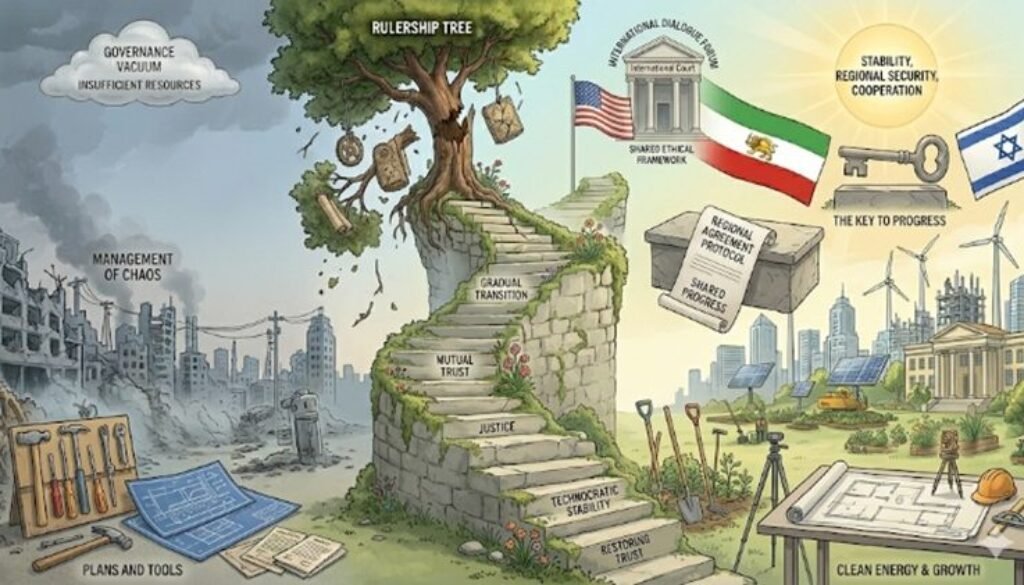
Position Paper: The Iranian Restoration and Stabilization Protocol (IRSP) – From Crisis Management to Strategic Stability
Prepared by: Lt. Col. (Res.) Kobi Lavy and Adv. Uri Shem Tov-Marom
- Introduction: Re-evaluating the Strategic Challenge
The ongoing dialogue between the international community—led by the United States—and Iran is underpinned by a profound sense of responsibility and a cautious approach toward regional dynamics. Washington’s apprehension regarding any scenario that might precipitate a governance vacuum or uncontrolled instability is a legitimate concern, reflecting the national security interests of the U.S. and its partners. This position paper does not challenge this prudent approach; rather, it introduces the "Iranian Restoration and Stabilization Protocol" (IRSP) as a strategic framework designed to integrate seamlessly into existing efforts to foster order and long-term stability.
- The Legal Core: A "Modern Nuremberg" Model Subject to the Rule of Law
Central to this proposal is a framework inspired by international legal principles, historically exemplified by the Nuremberg trials, aimed at restorative justice. It must be explicitly underscored: The viability of this legal pathway is entirely contingent upon adherence to the most rigorous evidentiary and legal standards.
Should a solid, irrefutable evidentiary basis be established—consistent with accepted international norms—for the conviction of senior regime and IRGC leadership for unlawful activities, this model may serve as a structured moral and legal avenue. This process is intended to provide a mechanism for restoring legitimacy to state institutions and decoupling them from policies inconsistent with international norms, while strictly upholding due process and professional judicial proceedings.
- Governance Stratification (Tiering System)
To proactively mitigate concerns regarding instability, this protocol proposes a structured distinction between various elements of the existing regime to ensure functional continuity:
- The Technocratic and Professional Echelon (Group B): Engineers, economists, infrastructure managers, and educators. Preserving their status and operational continuity is critical to preventing the chaos that the U.S. rightfully seeks to avoid, as these professionals constitute the "administrative glue" that sustains essential state services.
- Mid-Level Security Personnel (Group C): Providing a "Green Track" for those who prioritize stability and the dismantling of non-essential, hostile infrastructure. This may ensure an orderly and controlled transition process.
- Regime Leadership (Group A): Entities against whom a comprehensive legal evidentiary basis is established will be addressed according to accepted international mechanisms, strictly predicated on proven unlawful conduct.
- Restoring Public Trust as a Pillar of Stability
The protocol conveys a clear message to the Iranian public: justice will be pursued regarding those responsible for hostile activity, while state infrastructure essential for citizen welfare will be protected. As the populace in Tehran observes that the proposed alternative ensures the continuity of education, health, and welfare services, the fear of anarchy will diminish, significantly increasing the likelihood of cooperation with the transition process.
- Strategic Advantages for Western Policy
The IRSP framework is designed to assist policymakers in Washington and Jerusalem in managing this complex challenge:
- Supervision and Accountability: Facilitating the oversight of strategic assets while maintaining orderly governance continuity.
- Regional Stability: Transitioning from unpredictable outcomes to a managed, agreed-upon, and measured process, thereby securing the stability interests of all partners.
- A Strategic Framework for Resolution: The protocol provides the administration with professional tools to resolve the crisis in a manner that guarantees peace and security, utilizing a structured legal-administrative procedure.
- Conclusion
The objective proposed herein is to open a path for an informed strategic dialogue. By shifting the focus from managing the status quo to creating a stability framework based on established legal standards and the preservation of administrative continuity, we can assist decision-makers in exploring additional avenues for ensuring regional security. We believe this approach serves as a worthy foundation for mutual examination among allies, while maintaining the necessary responsibility and caution. The Iranian people—many of whom have experienced profound disappointment with the current state of affairs and the entrenchment of the existing regime—may find the motivation to champion this transition and become active partners in its leadership.
Selected Bibliography for Strategic Policy Analysis
Legal and International Frameworks:
- United Nations (1950). Principles of International Law Recognized in the Charter of the Nürnberg Tribunal and in the Judgment of the Tribunal.
- Rome Statute of the International Criminal Court (1998). Framework for the prosecution of crimes against humanity and war crimes.
Strategic Intelligence and Iranian Studies:
- Eisenstadt, M. (2023). The Iranian Regime’s Survival Strategy: Balancing Coercion and Co-optation. The Washington Institute for Near East Policy.
- Katzman, K. (2025). Iran’s Political and Economic Infrastructure: A Structural Analysis. Congressional Research Service (CRS).
- Zimmt, R. (2024). The IRGC and the Iranian Political Apparatus: Power Dynamics and Domestic Governance. Institute for National Security Studies (INSS).
Crisis Management and Transition Theory:
- Chesterman, S. (2004). You, the People: The United Nations, Transitional Administration, and State-Building. Oxford University Press.
- Diamond, L., & Plattner, M. F. (2015). Democratization and Authoritarianism in the Middle East. Johns Hopkins University Press.
- Fukuyama, F. (2004). State-Building: Governance and World Order in the 21st Century. Cornell University Press.